 Skip to content
‘Digital transformation’ has become one of the most used — and most misunderstood — phrases in the UK business lexicon. For some, it conjures images of expensive enterprise technology programmes with uncertain returns. For others, it is a vague aspiration that sounds impressive in strategy documents but lacks concrete meaning.
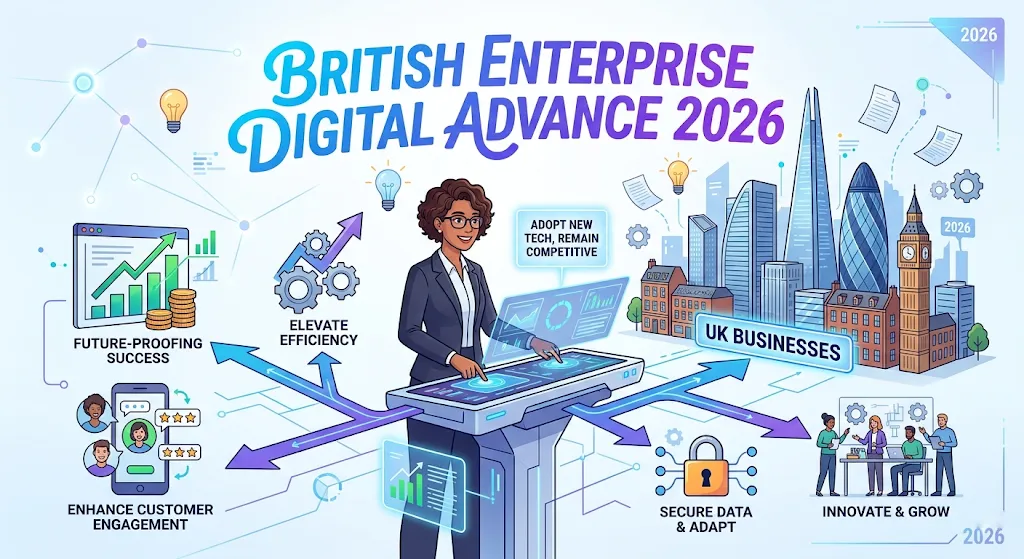
In reality, digital transformation is simply the process of using technology to improve how your business operates, delivers value to customers, and competes in your market. It is not a single project with a start and end date. It is an ongoing evolution — and for most UK businesses, starting it sooner is almost always better than waiting.
The Practical Meaning of Digital Transformation
Digital transformation looks different for every business, but at its core it involves: replacing manual, paper-based, or disconnected processes with digital, integrated, and automated equivalents; using data more effectively to understand your customers, operations, and performance; delivering your products and services through digital channels as well as (or instead of) traditional ones; and building a digital-first organisational culture that embraces technology as a competitive tool.
5 Signs Your UK Business Needs to Accelerate Its Digital Transformation
1. Your team wastes time on manual, repetitive data entry
If information that exists in one system is regularly being manually copied into another, you are paying for inefficiency that technology can eliminate almost entirely through integration and automation.
2. You are losing customers to more digitally capable competitors
If competitors are offering online booking, self-service portals, faster response times, or more personalised experiences — and you are not — digital transformation is a directly competitive priority.
3. You cannot easily access or act on your business data
If answering basic business questions (how many customers did we acquire last month? what is our most profitable product line?) requires significant manual effort or is simply not possible, your data architecture needs modernisation.
4. Your systems cannot support remote or hybrid working effectively
If your team’s productivity is significantly reduced when not in the office due to on-premise systems, paper-based processes, or poor cloud adoption, your technology is constraining your talent strategy.
5. Customer experience is being limited by your technology
If customers face friction — in placing orders, making enquiries, receiving updates, or resolving issues — because of technology limitations, those are direct revenue and retention risks.
Where to Start Your Digital Transformation Journey
The most common mistake in digital transformation is trying to do too much simultaneously. Start by identifying the 2–3 processes in your business that cause the most friction, consume the most time, or create the most customer experience problems. Transform these first, measure the results, and use that evidence to build the business case for the next phase.
Techcited Ltd’s Digital Transformation Service
Techcited Ltd supports UK businesses at every stage of their digital transformation journey — from initial assessment and roadmap development through to technology implementation, integration, and ongoing optimisation.
Frequently Asked Questions
Q: Is digital transformation only relevant for large businesses?
A: No. Small and medium businesses often benefit most from digital transformation because the efficiency gains, relative to their size, are proportionally larger. A small business that automates its invoicing and reporting, for example, frees up a significant percentage of its total administrative capacity.
Q: What is the difference between digitisation and digital transformation?
A: Digitisation is simply converting analogue processes to digital form (e.g., scanning paper documents). Digital transformation is broader — it involves redesigning how you work, deliver value, and compete using technology as a strategic enabler, not just a replacement for paper.
Q: How does Techcited Ltd support businesses beginning their digital transformation?
A: We start with a structured assessment of your current systems, processes, and pain points, then develop a prioritised transformation roadmap. We then support implementation, integration, and team training — acting as your technology partner throughout the journey.
Ready to get started?
Start your digital transformation journey with the right partner. Techcited Ltd provides practical, results-focused digital transformation support for UK businesses of all sizes. Visit: Digital Marketing Agency
