 Skip to content
The UK technology recruitment landscape in 2026 looks markedly different from even three years ago. Advances in artificial intelligence, shifts in candidate expectations, the normalisation of remote and hybrid working, and a growing emphasis on skills over credentials are all reshaping how technology businesses find, attract, and hire talent.
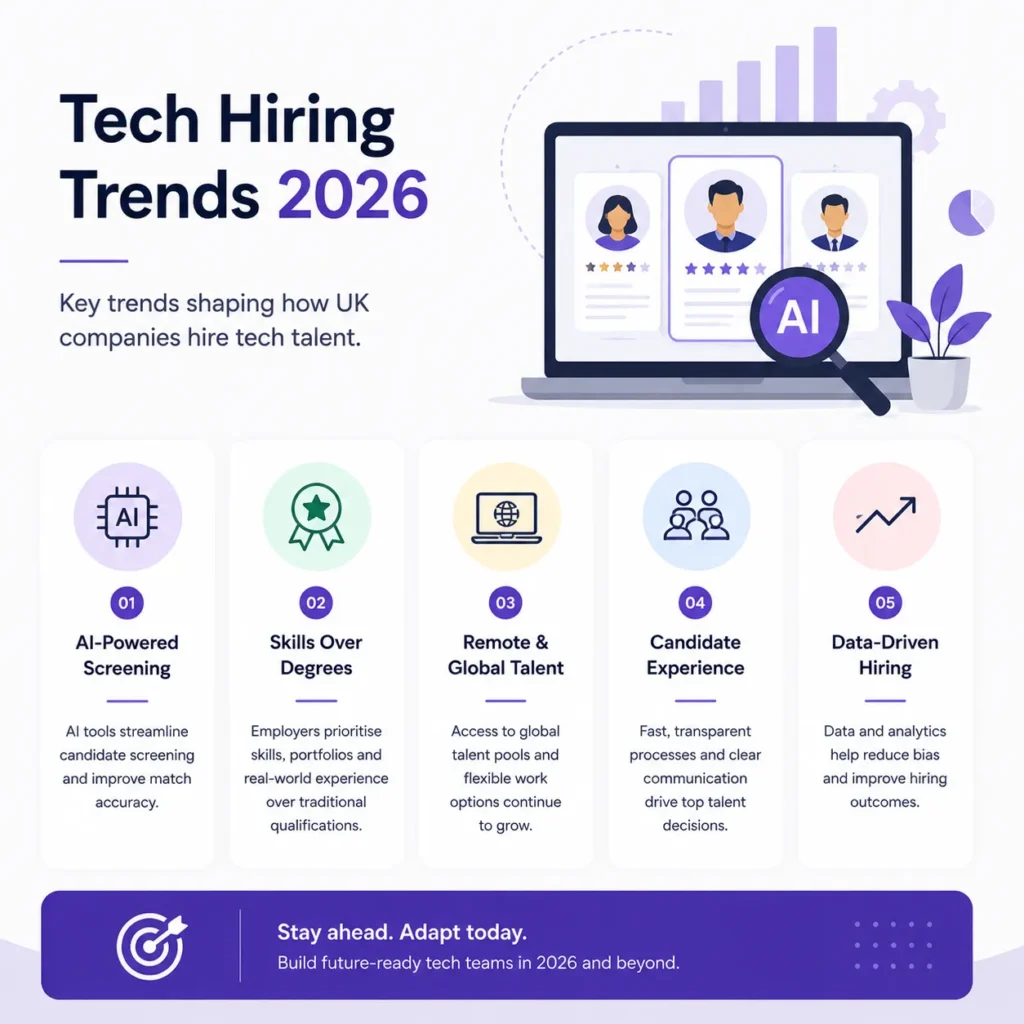
For UK employers and hiring managers, staying ahead of these trends is not just a competitive advantage — it is a necessity. Here is a comprehensive overview of the key developments transforming tech recruitment this year.
1. Skills-Based Hiring Is Replacing Credential-Based Hiring
One of the most significant shifts in UK tech hiring is the move away from degree requirements toward skills-based assessments. Leading technology companies — from global consultancies to Leicester-based digital agencies — are increasingly prioritising demonstrated ability over formal qualifications.
This shift benefits both employers and candidates. Employers gain access to a wider, more diverse talent pool. Candidates who have built skills through bootcamps, open-source contributions, or self-directed learning are now genuinely competitive with degree-holders for many roles.
2. AI-Assisted Recruitment Tools Are Mainstream
In 2026, AI-powered recruitment tools are no longer optional extras — they are core components of any competitive recruitment process. AI is being used to screen CVs, predict candidate success, reduce unconscious bias, and personalise candidate communications at scale.
However, the most effective organisations are using AI to augment human judgement, not replace it. The combination of AI efficiency in screening and human expertise in final-stage assessment consistently outperforms either approach in isolation.
3. Candidate Experience Has Become a Decisive Differentiator
With candidate expectations at an all-time high, businesses that offer a poor recruitment experience — slow responses, unclear processes, and impersonal communications — are being left behind. In 2026, candidates routinely share their experiences on LinkedIn, Glassdoor, and tech forums, meaning a bad hiring process has reputational consequences that extend well beyond a single vacancy.
4. Hybrid and Remote Work Expectations Are Non-Negotiable for Many Roles
The majority of experienced UK technology professionals now consider flexible or hybrid working arrangements as a baseline expectation, not a benefit. Employers insisting on five-day office attendance for roles that can be performed remotely are significantly restricting their accessible talent pool and increasing their competition for the minority of candidates who prefer office environments.
5. Diversity, Equity, and Inclusion in Tech Hiring Is Under Greater Scrutiny
Candidates increasingly scrutinise an employer’s commitment to DE&I before applying or accepting offers. Businesses with visible, actionable DE&I initiatives — not just policy statements — are attracting a more diverse and higher-quality candidate pool. In the technology sector, where diversity of thought drives innovation, this is a strategic as well as ethical priority.
How Techcited Ltd Stays Ahead of the Trends
At Techcited Ltd, we continuously update our recruitment methodology to reflect the latest developments in technology hiring. From skills-based assessment frameworks to structured DE&I sourcing approaches, we ensure our clients benefit from best-practice recruitment in a rapidly evolving market.
Frequently Asked Questions
Q: Is skills-based hiring suitable for all technology roles?
A: Skills-based hiring works exceptionally well for development, data, and cloud engineering roles where technical proficiency can be directly tested. For leadership and strategic roles, skills assessment is complemented by experience evaluation and leadership capability interviews.
Q: How can small UK businesses compete with large tech companies for talent in 2026?
A: Focus on what large companies cannot easily offer: genuine career impact, rapid progression, flexible working, close team relationships, and a clear sense of mission. Transparent communication about company culture and values is also highly effective for attracting candidates who prioritise purpose over prestige.
Q: What technologies are most in demand from UK employers hiring tech talent in 2026?
A: Python, React, Node.js, AWS, Azure, Kubernetes, Flutter, TypeScript, and data engineering tools (Spark, dbt, Snowflake) consistently appear at the top of UK tech hiring demand lists in 2026.
Ready to get started?
Techcited Ltd keeps your business ahead in the UK tech talent market. Contact us to discuss your 2026 recruitment strategy and how we can help you access the best technology professionals.
