Techcited Ltd

Author name: Techcited Ltd

SEO vs PPC: Which Should Your Small Business Invest In for 2026?
Uncategorized

SEO vs PPC: Which Should Your Small Business Invest In for 2026?

One of the most common digital marketing questions asked by UK small business owners is: should I invest in SEO or PPC? Both channels can drive significant website traffic and generate valuable leads — but they operate differently, suit different situations, and produce results on different timelines. This guide provides an honest, balanced comparison to help you make the right investment decision for your business. Understanding SEO (Search Engine Optimisation) SEO is the practice of optimising your website and content to rank higher in Google’s organic (unpaid) search results. When someone searches for a service you offer, SEO aims to place your website on Page 1 of Google’s results — without paying for each click. The major advantage of SEO is that organic traffic is free once achieved. A Page 1 ranking for a high-intent keyword (e.g., ‘IT consultant Leicester’) generates a continuous stream of relevant visitors at no per-click cost. However, SEO is a long-term investment — competitive keywords typically take 3–6 months of consistent effort to achieve meaningful ranking improvement. Understanding PPC (Pay-Per-Click Advertising) PPC — primarily Google Ads Search — allows you to pay to appear at the top of search results for specific keywords, immediately. You pay only when someone clicks your ad. The cost per click varies from under £1 for low-competition local terms to £20–£50+ for highly competitive national keywords. PPC delivers traffic from day one — immediately after campaign setup and activation. It also provides precise control over budget, targeting, timing, and messaging. However, the traffic stops the moment you stop paying. Unlike SEO, PPC builds no permanent asset. Head-to-Head Comparison Speed of Results PPC: immediate. SEO: 3–6+ months for competitive terms. For businesses that need results now — new businesses, seasonal campaigns, product launches — PPC delivers faster. For established businesses planning for long-term growth, SEO delivers superior long-term returns. Cost per Acquisition Over time, well-optimised SEO typically delivers a lower cost per lead than PPC, because organic traffic is free. In the short term, PPC’s immediate results often justify the per-click cost during the period SEO is building momentum. Scalability PPC scales immediately with budget — spend more, get more traffic. SEO scales more slowly but sustainably — rankings and authority build incrementally. For high-growth phases, PPC provides the flexibility to accelerate quickly. The Honest Answer: Use Both For most UK small businesses with realistic digital marketing budgets, the optimal approach is to invest in SEO as the long-term foundation while using PPC strategically for immediate lead generation, seasonal campaigns, and keyword gaps where organic rankings are not yet established. Techcited Ltd’s digital marketing service integrates SEO, content strategy, and Google Ads management — ensuring our clients generate leads from the day they engage us while building sustainable organic authority for the long term. Frequently Asked Questions Q: How much does Google Ads cost for a UK small business? A: A realistic minimum Google Ads budget for a UK small business is £300–£500 per month in ad spend, plus management fees. For professional services and technology companies targeting competitive keywords, £700–£2,000 per month delivers more meaningful scale. Q: Can I do SEO myself or do I need an agency? A: Basic technical SEO and content creation can be done in-house with the right knowledge and tools. However, the time investment is significant, and the technical aspects of SEO — backlink building, technical audits, and Core Web Vitals optimisation — benefit significantly from professional expertise. Q: How does Techcited Ltd structure its SEO and PPC services? A: We offer SEO and Google Ads management as individual services and as an integrated Digital Marketing Package. Contact us to discuss which approach suits your business goals and budget. Ready to get started? Get expert SEO and PPC management for your UK business from Techcited Ltd. We build integrated digital marketing strategies that deliver results from day one and grow over time. Visit: Digital marketing agency

What Is Digital Transformation and Why Does Your UK Business Need It Now?
Uncategorized

What Is Digital Transformation and Why Does Your UK Business Need It Now?

‘Digital transformation’ has become one of the most used — and most misunderstood — phrases in the UK business lexicon. For some, it conjures images of expensive enterprise technology programmes with uncertain returns. For others, it is a vague aspiration that sounds impressive in strategy documents but lacks concrete meaning. In reality, digital transformation is simply the process of using technology to improve how your business operates, delivers value to customers, and competes in your market. It is not a single project with a start and end date. It is an ongoing evolution — and for most UK businesses, starting it sooner is almost always better than waiting. The Practical Meaning of Digital Transformation Digital transformation looks different for every business, but at its core it involves: replacing manual, paper-based, or disconnected processes with digital, integrated, and automated equivalents; using data more effectively to understand your customers, operations, and performance; delivering your products and services through digital channels as well as (or instead of) traditional ones; and building a digital-first organisational culture that embraces technology as a competitive tool. 5 Signs Your UK Business Needs to Accelerate Its Digital Transformation 1. Your team wastes time on manual, repetitive data entry If information that exists in one system is regularly being manually copied into another, you are paying for inefficiency that technology can eliminate almost entirely through integration and automation. 2. You are losing customers to more digitally capable competitors If competitors are offering online booking, self-service portals, faster response times, or more personalised experiences — and you are not — digital transformation is a directly competitive priority. 3. You cannot easily access or act on your business data If answering basic business questions (how many customers did we acquire last month? what is our most profitable product line?) requires significant manual effort or is simply not possible, your data architecture needs modernisation. 4. Your systems cannot support remote or hybrid working effectively If your team’s productivity is significantly reduced when not in the office due to on-premise systems, paper-based processes, or poor cloud adoption, your technology is constraining your talent strategy. 5. Customer experience is being limited by your technology If customers face friction — in placing orders, making enquiries, receiving updates, or resolving issues — because of technology limitations, those are direct revenue and retention risks. Where to Start Your Digital Transformation Journey The most common mistake in digital transformation is trying to do too much simultaneously. Start by identifying the 2–3 processes in your business that cause the most friction, consume the most time, or create the most customer experience problems. Transform these first, measure the results, and use that evidence to build the business case for the next phase. Techcited Ltd’s Digital Transformation Service Techcited Ltd supports UK businesses at every stage of their digital transformation journey — from initial assessment and roadmap development through to technology implementation, integration, and ongoing optimisation. Frequently Asked Questions Q: Is digital transformation only relevant for large businesses?A: No. Small and medium businesses often benefit most from digital transformation because the efficiency gains, relative to their size, are proportionally larger. A small business that automates its invoicing and reporting, for example, frees up a significant percentage of its total administrative capacity. Q: What is the difference between digitisation and digital transformation?A: Digitisation is simply converting analogue processes to digital form (e.g., scanning paper documents). Digital transformation is broader — it involves redesigning how you work, deliver value, and compete using technology as a strategic enabler, not just a replacement for paper. Q: How does Techcited Ltd support businesses beginning their digital transformation?A: We start with a structured assessment of your current systems, processes, and pain points, then develop a prioritised transformation roadmap. We then support implementation, integration, and team training — acting as your technology partner throughout the journey. Ready to get started? Start your digital transformation journey with the right partner. Techcited Ltd provides practical, results-focused digital transformation support for UK businesses of all sizes. Visit: Digital Marketing Agency

Digital Marketing Strategy for Small Businesses in Leicester
Uncategorized

Digital Marketing Strategy for Small Businesses in Leicester: A 2026 Guide

For a small business in Leicester, having a clear, actionable digital marketing strategy is no longer optional — it is the foundation on which sustainable growth is built. Whether you are a professional services firm, a retail business, a restaurant, or a technology company, your potential customers are searching for what you offer online, comparing providers, and making decisions based on the quality of your digital presence. This guide provides a practical six-step digital marketing framework specifically designed for Leicester small businesses looking to build consistent, measurable online growth in 2026. Step 1: Define Your Target Audience With Precision Every effective marketing strategy starts with a clear understanding of who you are marketing to. Generic messaging that attempts to appeal to everyone ends up resonating with no one. Create specific customer personas that describe your ideal customers by demographics, job roles, challenges, goals, and the online platforms where they spend their time. For a Leicester business, your target audience analysis should also include geographic nuance — considering whether your customers are local (within the city), regional (East Midlands), national, or a mix. This determines which channels and what level of local SEO investment is appropriate. Step 2: Establish Your Digital Marketing Foundations Before investing in paid advertising or content marketing, ensure your foundations are solid. This means: a fast, mobile-first professional website, a fully completed and verified Google Business Profile, consistent NAP (Name, Address, Phone) information across all online directories, and active social media profiles on the platforms where your customers spend time. Step 3: Invest in Local SEO For most Leicester small businesses, local SEO — optimising for searches with geographic intent (e.g., ‘web developer Leicester’, ‘accountant near me’) — offers the highest near-term return on digital marketing investment. Local SEO drives qualified, purchase-intent visitors from people in your geographic area who are actively looking for your services. Key local SEO activities include: optimising and consistently updating your Google Business Profile, building local citations in relevant UK directories (Yell, Thomson Local, Bing Places), earning reviews from genuine customers, and creating location-specific content on your website. Step 4: Develop a Content Strategy Consistent, valuable content builds your brand’s authority and drives organic search traffic over time. For most small businesses, a blog publishing 2–4 posts per month covering the topics your potential customers search for is both achievable and highly effective. Each post should target a specific keyword, provide genuine value, and include a clear call-to-action. Step 5: Build and Grow Your Social Media Presence Choose 1–2 social media platforms based on where your target customers are most active — not where you feel most comfortable. For B2B Leicester businesses, LinkedIn is typically the highest-value platform. For consumer-facing businesses, Instagram and Facebook generate the most direct engagement. Publish consistently rather than sporadically — 3–4 posts per week at consistent times outperforms daily posting for a week followed by silence. Step 6: Add Paid Channels Strategically Once your organic foundations are established, paid digital advertising can accelerate growth significantly. Google Ads (Search) targets people actively searching for your services. Facebook and Instagram Ads build awareness and retarget website visitors. Even small budgets (£200–£500 per month) can generate significant results when campaigns are well-structured and managed. Techcited Ltd: Your Leicester Digital Marketing Partner Techcited Ltd provides comprehensive digital marketing services for small and medium businesses across Leicester and the UK. From SEO and content strategy to social media management and paid advertising, our team delivers measurable results that grow your business online. Frequently Asked Questions Q: How long does it take to see results from digital marketing for a Leicester business?A: SEO typically takes 3–6 months to deliver significant organic traffic growth. Social media engagement builds over 2–3 months of consistent activity. Paid advertising can deliver results from week one. A comprehensive strategy combining all channels delivers the fastest sustainable growth. Q: Should a small Leicester business focus on local or national digital marketing?A: Start with local. Ranking for ‘your service + Leicester’ or ‘your service + East Midlands’ is significantly more achievable than national competition, delivers highly qualified local leads, and builds the credibility foundation for broader national expansion. Q: How much should a small Leicester business invest in digital marketing per month?A: A realistic starting budget for a comprehensive small business digital marketing programme in Leicester is £500–£1,500 per month, covering SEO, content, social media management, and a basic paid advertising component. Returns on this investment compound significantly over time. Ready to get started? Ready to build a digital marketing strategy for your Leicester business? Contact Techcited Ltd for a free digital marketing consultation and let us help you grow online. Visit: Digital Marketing Agency

How to Choose the Right Recruitment Agency in Leicester A 2026 Guide
Uncategorized

How to Choose the Right Recruitment Agency in Leicester: A 2026 Guide

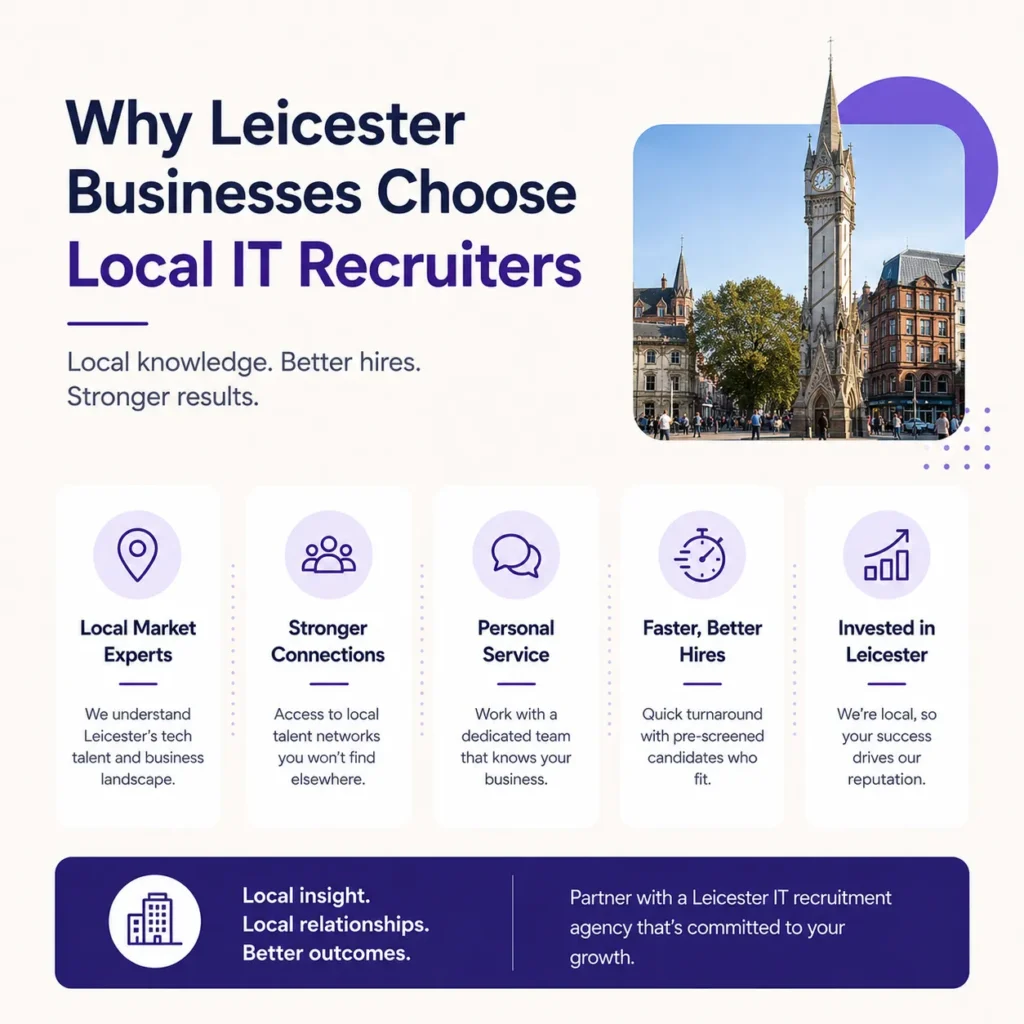
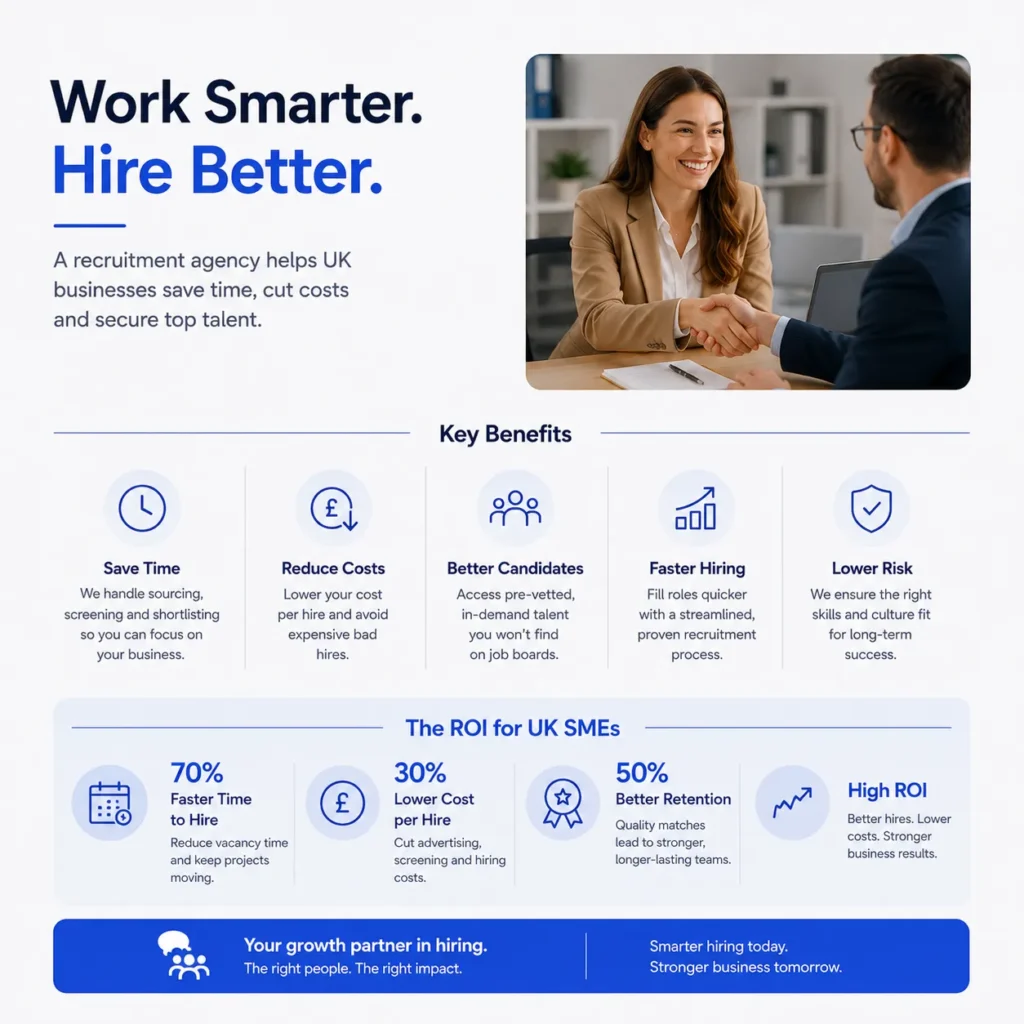
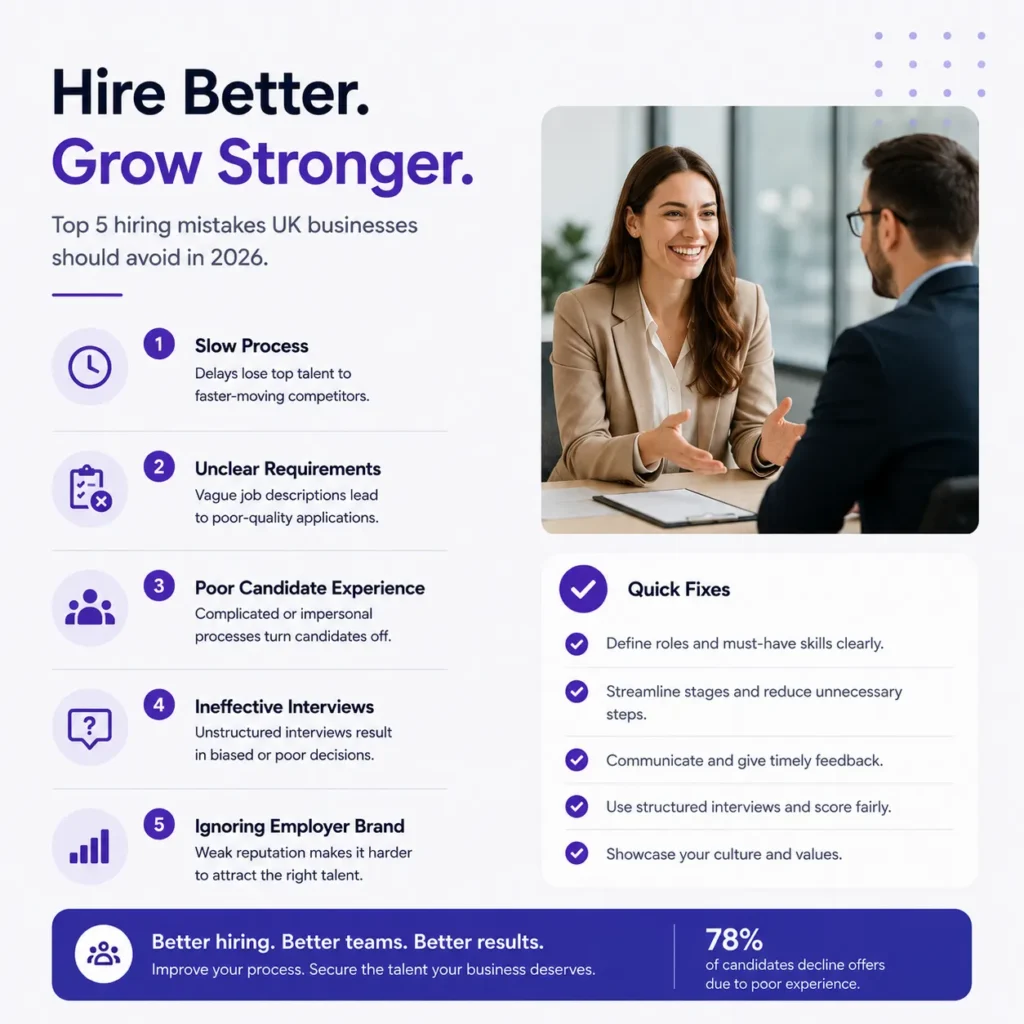
Finding the right recruitment agency in Leicester can be the difference between filling a role in days and spending months wading through unsuitable applications. With dozens of agencies competing for your attention, knowing what to look for — and what to avoid — is essential for any business owner or HR manager in 2026. This guide walks you through exactly how to evaluate and choose a recruitment agency that will genuinely serve your business needs, whether you are hiring for a single specialist role or building an entire team. Why Using a Recruitment Agency in Leicester Makes Business Sense Leicester has one of the most diverse and rapidly growing business communities in the East Midlands. From technology start-ups and logistics firms to healthcare providers and professional services companies, the demand for skilled talent is consistently high — and competition for top candidates is fierce. A well-connected local recruitment agency understands the Leicester talent market intimately. They know which skill sets are readily available, which roles typically take longer to fill, and which compensation packages are required to attract the best candidates. This local knowledge saves you significant time and reduces the risk of a costly mis-hire. Beyond local expertise, working with an agency means you gain immediate access to a pre-screened pool of active and passive candidates — people who may not be responding to job boards but who are open to the right opportunity when it is presented correctly. The 7 Key Criteria for Choosing a Recruitment Agency 1. Sector Specialisation Always verify that the agency has genuine experience recruiting in your industry. A generalist agency may lack the technical understanding needed to accurately assess candidates for specialist roles such as software developer, data analyst, or IT project manager. Ask for evidence of recent placements in your sector. 2. Candidate Pool Quality Ask how the agency sources candidates. Do they rely solely on job boards, or do they proactively headhunt passive candidates through LinkedIn and professional networks? The best agencies maintain a warm talent pool and can present shortlisted candidates within days, not weeks. 3. Screening and Vetting Process A quality agency does not simply forward CVs. They conduct structured interviews, verify qualifications and employment history, assess cultural fit, and provide you with a brief candidate profile alongside each CV. If an agency cannot explain their screening methodology, consider it a red flag. 4. Transparent Pricing and Fee Structures Recruitment agency fees are typically calculated as a percentage of the candidate’s first year salary — usually between 10% and 20% for permanent placements. Ensure the fee structure is clear, written, and includes details of any rebate or guarantee period should the placement not work out. 5. Communication and Responsiveness You should never be left wondering what is happening with your vacancy. Your recruitment consultant should provide regular updates, be reachable when you need them, and keep you informed at every stage. Poor communication early in the relationship is unlikely to improve once you are committed. 6. Technology and Modern Recruitment Tools In 2026, the best agencies use AI-assisted CV screening, applicant tracking systems, and video interview platforms to improve both speed and quality. An agency that still relies entirely on paper-based processes or email chains is operating well behind the curve. 7. Reviews, References, and Track Record Check Google reviews, Trustpilot, and LinkedIn recommendations. Ask the agency for references from businesses similar to yours. A strong track record in your sector, supported by verified client feedback, is one of the strongest signals of a reliable recruitment partner. Red Flags to Watch Out For Why Techcited Ltd Is Leicester’s Trusted Recruitment Partner At Techcited Ltd, we specialise in IT and technology recruitment across Leicester and the wider UK. Our team combines deep sector knowledge with a rigorous candidate vetting process, ensuring that every candidate we present genuinely meets your technical and cultural requirements. We work closely with businesses of all sizes — from agile start-ups to established enterprises — and our consultants are available to support you from the initial vacancy brief through to successful onboarding. Our transparent fee structures, genuine sector expertise, and 5-star Google rating reflect our commitment to delivering results. Whether you are looking to hire a software developer, project manager, data analyst, or technical support specialist, our team can help you find the right person — quickly, professionally, and cost-effectively. Frequently Asked Questions Q: How long does it typically take to fill a role through a recruitment agency in Leicester?A: For most professional and IT roles, a well-prepared recruitment agency should be able to present a shortlist of qualified candidates within 5–10 working days. Highly specialist roles may take 2–4 weeks. Providing a detailed job brief and responding promptly to candidate CVs significantly speeds up the process. Q: What is the typical recruitment agency fee for permanent placements in the UK?A: Permanent placement fees generally range from 10% to 20% of the candidate’s first year base salary. Many agencies offer a rebate or replacement guarantee — typically 8 to 12 weeks — should the hire leave or be released within that period. Q: Can a recruitment agency in Leicester help with remote and hybrid roles?A: Yes. Post-pandemic, most UK recruitment agencies actively manage vacancies for remote and hybrid positions and have candidate databases spanning the entire UK, not just their local area. Techcited Ltd recruits nationally for remote technology roles. Ready to get started? Ready to find your next great hire? Contact the Techcited Ltd recruitment team today for a free consultation and let us help you source the right talent — fast. Visit: Recruitment agency in leicesteruk

Scroll to Top