...

Techcited Ltd

Recruitment

How to Build a Talent Pipeline for Your Tech Business: A Strategic Guide
Recruitment

How to Build a Talent Pipeline for Your Tech Business: A Strategic Guide

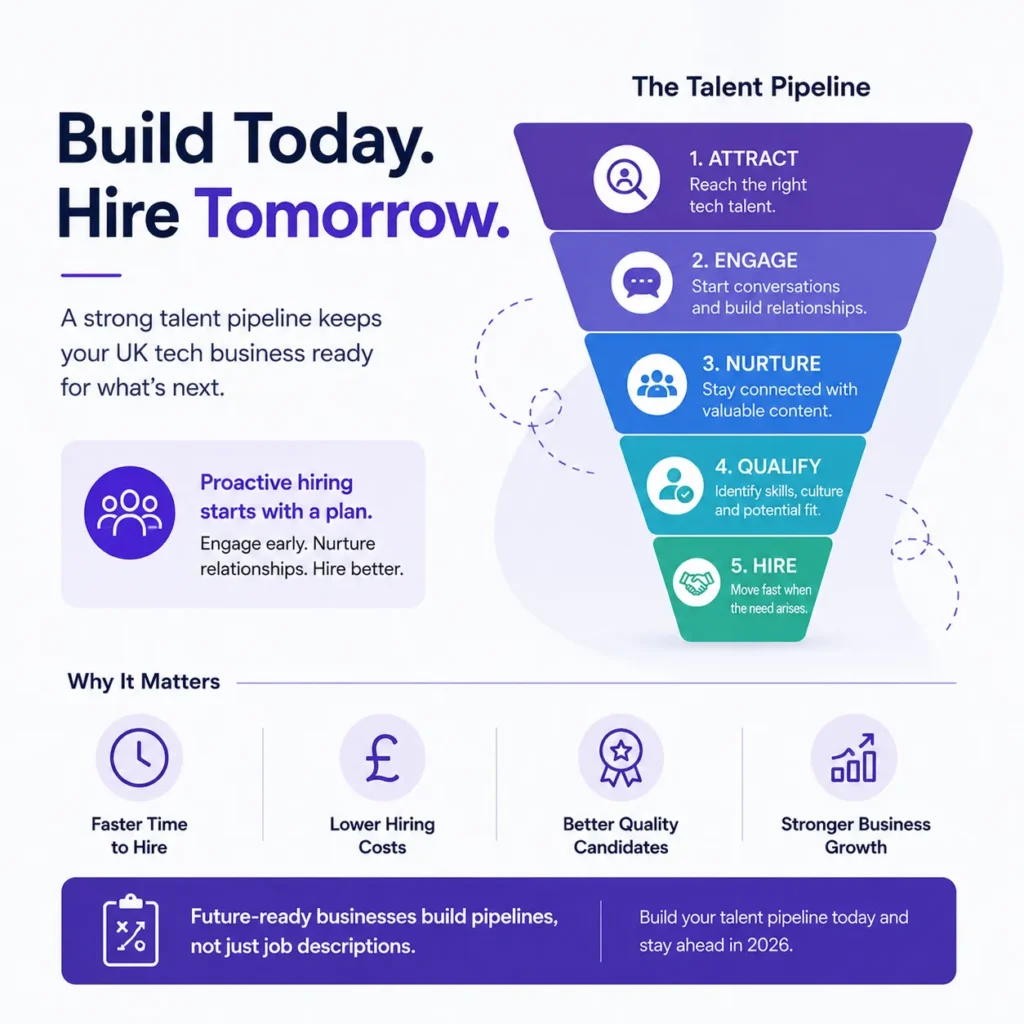
Most businesses recruit reactively — a role becomes vacant, a process begins, a hire is eventually made. This reactive approach is expensive, slow, and often results in compromise. The businesses that consistently hire the best technology talent operate differently: they maintain a proactive talent pipeline that means they are never starting from scratch when a vacancy arises. This guide explains what a talent pipeline is, why it matters, and exactly how to build one for your UK technology business in 2026. What Is a Talent Pipeline? A talent pipeline is a curated, relationship-managed pool of potential future hires — candidates who have been identified as a strong fit for your business and with whom you maintain periodic, low-pressure contact. When a vacancy arises, you already have qualified, engaged candidates to approach immediately, rather than beginning a cold search. Why Talent Pipelines Matter More in 2026 The UK technology talent market remains highly competitive. For specialist roles — cloud engineers, senior developers, AI/ML specialists — the available talent pool is limited and in high demand. The businesses that have pre-existing relationships with these professionals will always move faster and with greater success than those starting each search from zero. Step 1: Define Your Future Hiring Needs Start by working with your leadership team to map likely hiring needs over the next 12–18 months. Which roles are likely to expand? What skills gaps are emerging as your technology strategy evolves? Which roles are high-risk if they become vacant unexpectedly? This roadmap becomes the foundation of your pipeline strategy. Step 2: Identify and Map Target Candidates Use LinkedIn, GitHub, tech community events, and industry publications to identify professionals who match your future needs. You are not recruiting them — you are making note of them. Follow their content. Connect. Engage genuinely with their work before any hiring conversation is appropriate. Step 3: Build Genuine Relationships Over Time A talent pipeline is built on authentic professional relationships, not transactional contact. Share relevant content. Make introductions. Invite strong candidates to company events or webinars. When the time comes to discuss a role, the foundation of mutual trust is already in place. Step 4: Partner With a Specialist Recruitment Agency A specialist IT recruitment agency like Techcited Ltd brings an existing, warm talent pipeline that you can access on demand. Rather than building your own pipeline from scratch — a process that takes time and resource — a recruitment partnership immediately extends your reach to thousands of pre-assessed candidates. Step 5: Maintain and Refresh Your Pipeline Regularly A pipeline that is not actively maintained quickly becomes stale. Set a quarterly review to assess which candidates are still relevant, who has moved on, and which new individuals should be added. Consistent, lightweight engagement keeps relationships warm without demanding significant time. Frequently Asked Questions Q: How long does it take to build an effective talent pipeline? A: Building a meaningful talent pipeline from scratch typically takes 6–12 months of consistent effort. However, partnering with a recruitment agency like Techcited Ltd provides immediate access to an established, maintained pipeline. Q: Can a talent pipeline strategy work for small businesses with limited HR resources? A: Yes. Even a small business can maintain a simple pipeline spreadsheet of 20–30 strong candidates across 4–5 key roles, with quarterly touchpoint reminders. The investment is in relationship quality, not infrastructure. Q: What is the difference between a talent pool and a talent pipeline? A: A talent pool is a broad database of potential candidates. A talent pipeline is a more structured, actively managed set of relationships with specific individuals mapped to specific future roles — a more strategic and productive approach. Ready to get started? Techcited Ltd can be your strategic talent pipeline partner — maintaining relationships with top UK tech professionals on your behalf. Book a free consultation to find out more.
The Top IT Skills UK Employers Are Looking for in 2026
Recruitment

The Top IT Skills UK Employers Are Looking for in 2026

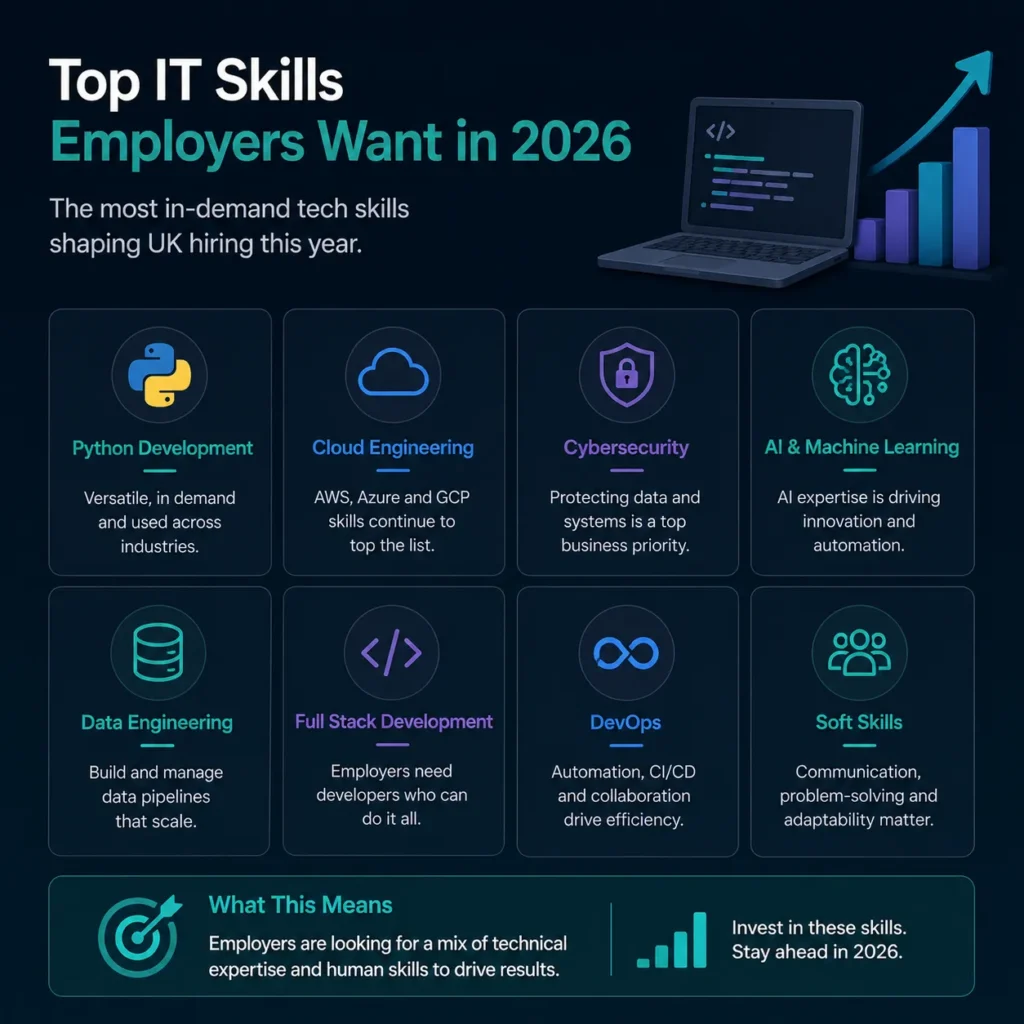
The technology skills landscape shifts rapidly and staying current on which capabilities are most valued by UK employers is essential — whether you are hiring, building a training programmed, or advising your team on professional development. Based on current UK job market data and Techcited Ltd’s direct recruitment activity, here are the technology skills and disciplines attracting the highest demand and strongest salaries in 2026. Cloud Engineering and Architecture (AWS, Azure, GCP) Cloud expertise remains at the top of almost every UK technology employer’s wish list. Proficiency in AWS, Microsoft Azure, or Google Cloud Platform — particularly at the solution architect or DevOps engineer level — commands premium salaries and is consistently in short supply relative to demand. Python and Data Engineering Python has firmly established itself as the lingua franca of modern software development and data engineering. Skills in data pipeline development, ETL processes, Spark, dbt, and cloud data warehouses (Snowflake, BigQuery, Redshift) are exceptionally sought after across industries including finance, healthcare, retail, and logistics. React and Next.js Front-End Development React remains the dominant front-end JavaScript framework, with Next.js growing rapidly as the framework of choice for full-stack web applications. Front-end developers with strong React and TypeScript skills are consistently in demand from digital agencies, product companies, and in-house technology teams. Cybersecurity and Information Security With the volume and sophistication of cyber threats increasing year on year, cybersecurity professionals are among the most sought-after in the entire UK technology market. Security Operations (SOC) analysts, penetration testers, cloud security architects, and GRC specialists are all in significant demand. Flutter and Mobile App Development Flutter — Google’s cross-platform mobile development framework — has become the go-to choice for businesses seeking to build high-quality iOS and Android applications from a single codebase. Flutter developers are in particularly strong demand from UK startups and SMEs. AI and Machine Learning Engineering The rapid expansion of commercial AI applications has created significant demand for ML engineers and AI application developers. Proficiency in large language model integration, Python ML libraries (PyTorch, TensorFlow, Scikit-learn), and MLOps platforms is increasingly sought after across sectors. IT Project Management and Delivery Qualified project and programme managers with genuine technology delivery experience remain consistently in demand. Certifications such as PRINCE2, AgilePM, and PMI PMP — combined with practical delivery track records — attract strong salaries in both permanent and contract markets. Frequently Asked Questions Q: What is the average salary for a software developer in Leicester in 2026? A: Salaries for software developers in Leicester vary by specialism and experience. Mid-level developers typically earn £40,000–£60,000; senior developers £60,000–£80,000+. Specialist skills in cloud, AI, or cybersecurity command a premium. Contact Techcited Ltd for current market salary benchmarks. Q: Should businesses upskill existing staff or hire for new tech skills? A: Both approaches have merit. Upskilling builds loyalty and institutional knowledge; hiring brings fresh perspectives and immediate capability. For critical gaps in rapidly evolving areas like AI or cloud, external hiring often delivers faster results while internal upskilling is pursued in parallel. Q: Are bootcamp graduates competitive with computer science degree holders for IT roles? A: Increasingly yes, particularly for front-end and full-stack development roles. Bootcamp graduates who can demonstrate strong portfolios, GitHub activity, and genuine problem-solving capability are highly competitive with degree holders for many positions. Ready to get started? Looking to hire professionals with any of these in-demand IT skills? Techcited Ltd specialises in sourcing top UK technology talent. Contact us to discuss your requirements.

How to Successfully Onboard New IT Employees: A Step-by-Step Guide for UK Businesses
Recruitment

How to Successfully Onboard New IT Employees: A Step-by-Step Guide for UK Businesses

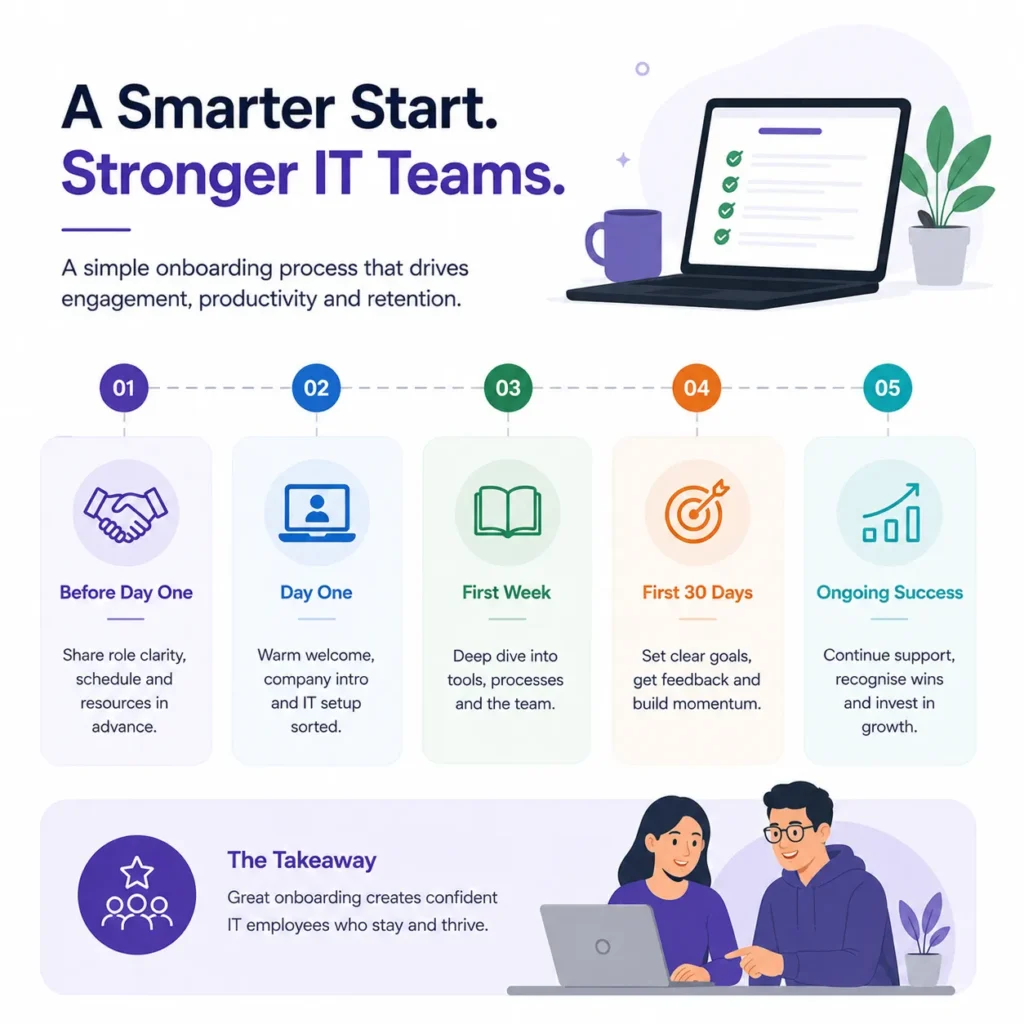
The cost of a failed hire is well documented — typically 1 to 3 times the employee’s annual salary. What is less frequently discussed is how much of that failure is caused not by the wrong hire, but by poor onboarding. Research by Glassdoor found that organisations with a strong onboarding process improve new hire retention by 82% and productivity by over 70%. For IT and technology roles — where ramp-up time is particularly significant — effective onboarding is a direct driver of business performance. This step-by-step guide provides a practical framework for UK businesses. Before Day One: Preboarding Week One: Orientation and Relationships The first week should focus on building relationships, not delivering tasks. New employees need to understand the organisation’s structure, culture, communication norms, and team dynamics before they can contribute effectively. Arrange brief introductory calls with all key stakeholders, including other teams whose work intersects with theirs. Provide a clear overview of the tech stack, existing systems, current projects, and immediate priorities. Avoid overwhelming new team members with information — space sessions across the week with time for independent exploration. Month One: Structured Learning and Early Wins Set clear, achievable goals for the first 30 days. For a developer, this might mean completing their first meaningful feature contribution. For an IT manager, it might mean reviewing the current infrastructure and producing a brief assessment. Early wins build confidence, demonstrate progress, and signal to the new hire that their contribution is valued. The 30-60-90 Day Framework A formal 30-60-90 day plan — with defined goals, success metrics, and review checkpoints at each stage — provides structure for both the new employee and their manager. At 90 days, conduct a formal review that celebrates progress, addresses any concerns openly, and sets the trajectory for the next quarter. How Techcited Ltd Supports Post-Placement Success Techcited Ltd does not consider our role finished at placement. We follow up with both the placed candidate and the client business at 1 week, 1 month, and 3 months to ensure the integration is progressing well. If any concerns arise, our consultants are available to advise and support both parties. Frequently Asked Questions Q: How long does it typically take for a new IT employee to become fully productive? A: For most technical roles, a new employee reaches full independent productivity between 3 and 6 months. Strong preboarding, a structured onboarding plan, and an assigned technical mentor can reduce this timeline significantly. Q: What is the single most important factor in new IT employee retention? A: Research consistently points to the quality of the direct manager relationship as the strongest predictor of early retention. New employees who feel supported, valued, and genuinely included by their manager are significantly more likely to remain. Q: Should onboarding be the same for contract/temporary staff as permanent employees? A: While shorter by necessity, contract staff onboarding should still include clear access to systems, introduction to key contacts, and a brief overview of the project and team context. Neglecting contractor onboarding leads to slower integration and lower productivity. Ready to get started? From recruitment through to successful onboarding, Techcited Ltd supports your entire talent journey. Contact us to find out more about our end-to-end IT recruitment service.

Diversity and Inclusion in Tech Hiring: Best Practices for UK Businesses
Recruitment

Diversity and Inclusion in Tech Hiring: Best Practices for UK Businesses in 2026

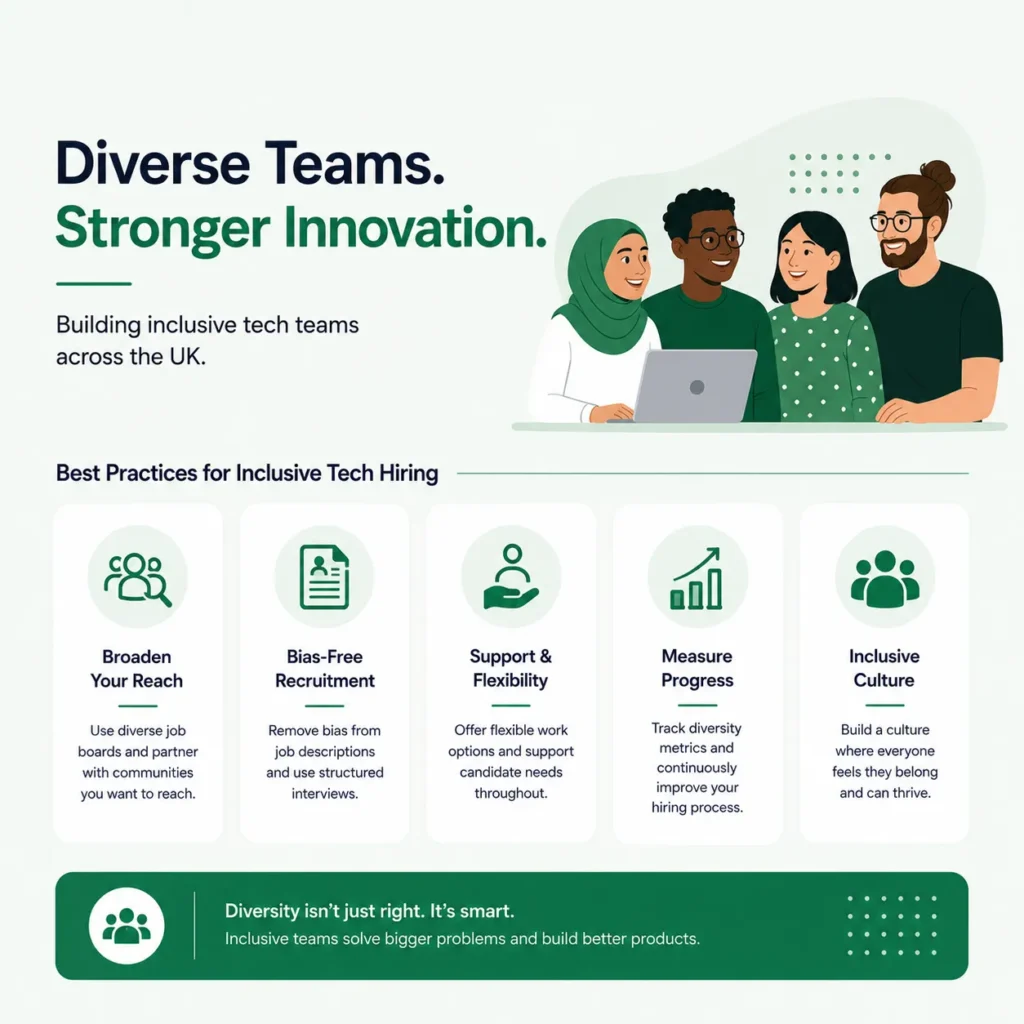
The UK technology sector has made progress on diversity and inclusion, but significant gaps remain. Women represent just 26% of the UK tech workforce. Ethnic minority professionals are underrepresented at senior levels. Neurodivergent candidates frequently encounter recruitment processes that do not accommodate their strengths. And socioeconomic background continues to influence access to tech careers in ways that are rarely discussed openly. For businesses that are serious about building genuinely diverse technology teams — not just meeting targets or satisfying governance requirements — the following best practices provide a practical foundation. Start With Bias-Aware Job Descriptions Research shows that certain language patterns in job descriptions measurably deter applications from women and ethnic minority candidates. Aggressive action verbs (‘dominate’, ‘crush’, ‘aggressive growth’), unnecessary credential requirements, and long lists of ‘must-have’ skills all reduce application diversity. Use tools like Textio or Gender Decoder to review job description language before posting. Expand Your Sourcing Channels If you are only advertising on mainstream job boards and LinkedIn, you are primarily reaching the candidates who are already well-represented in the tech sector. Expand your sourcing to include: coding bootcamp networks, women in tech communities (e.g., Code First Girls, Technation), ethnic minority professional networks, and neurodiversity-focused recruitment partners. Use Structured, Competency-Based Interviews Unstructured interviews are one of the primary causes of affinity bias in hiring — interviewers unconsciously favouring candidates who remind them of themselves. Structured interviews, with consistent questions across all candidates and pre-defined scoring frameworks, significantly reduce this effect and produce more objective, legally defensible hiring decisions. Make Reasonable Adjustments Proactively Do not wait for candidates to request adjustments. Proactively ask all candidates whether they require any accommodations to perform at their best during the recruitment process. This normalises adjustment requests, removes the perceived stigma of asking, and signals genuine inclusion commitment before a candidate has even joined your team. Measure, Track, and Report You cannot improve what you do not measure. Track application rates, interview progression, offer acceptance rates, and hiring outcomes by demographic category. Review this data quarterly and use it to identify and address specific gaps in your process. How Techcited Ltd Supports Diverse Tech Hiring Techcited Ltd actively promotes diversity in all recruitment activities. We use structured screening processes, actively source from diverse candidate communities, and work with clients to identify and reduce bias in their hiring practices. Our goal is to help you build technology teams that reflect the diverse communities and customers your business serves. Frequently Asked Questions Q: Is diversity hiring about lowering the bar for candidates? A: No. Diversity hiring is about removing artificial barriers that prevent qualified candidates from accessing opportunities. The goal is to ensure your recruitment process assesses genuine capability fairly, not to compromise on quality. Q: What are the business benefits of diverse technology teams? A: Research consistently links team diversity to better problem-solving, higher innovation rates, improved customer understanding, and stronger financial performance. McKinsey’s research shows that companies in the top quartile for ethnic diversity outperform less diverse peers on profitability. Q: How can small businesses prioritise DE&I without a dedicated HR team? A: Start with the basics: review job description language, expand sourcing channels, use structured interviews, and ask candidates about adjustments. These actions require no budget and make a significant difference. Techcited Ltd can also advise on practical DE&I recruitment approaches as part of our service. Ready to get started? Techcited Ltd helps UK businesses build diverse, high-performing technology teams. Contact us to discuss your inclusive recruitment strategy.

Why Leicester Businesses Are Choosing Local Recruitment Agencies
Recruitment

Why Leicester Businesses Are Choosing Local Recruitment Agencies in 2026

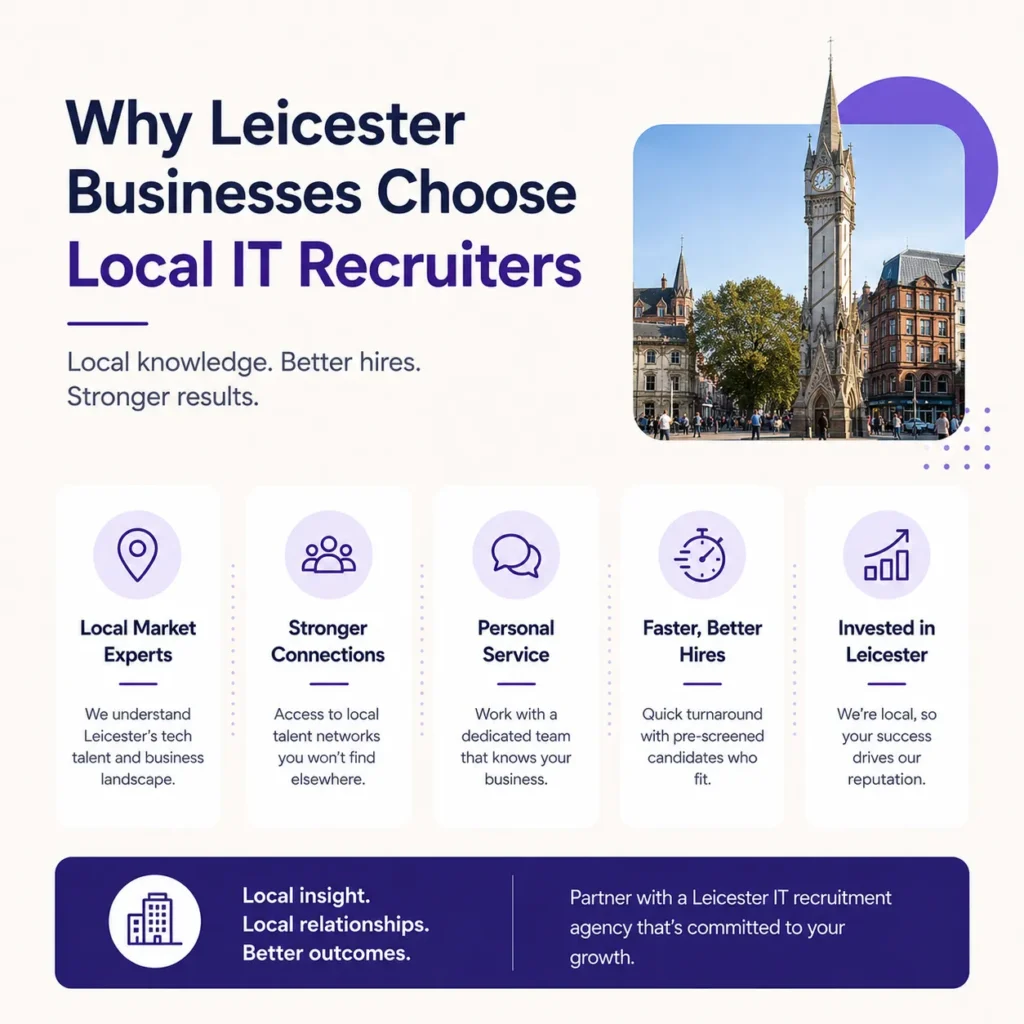
When Leicester businesses need to hire — particularly for technology and professional roles — the choice between a large national recruitment agency and a well-established local partner is increasingly being decided in favour of the local option. Here is why. Local Market Knowledge Is Genuinely Valuable A Leicester-based recruitment agency understands the local talent landscape in a way that a national operation with a regional presence cannot replicate. They know which local businesses are expanding or contracting, which universities are producing relevant graduates, what salary benchmarks look like for roles in the East Midlands versus London, and which neighbourhoods, transport links, and lifestyle factors influence candidate decisions. This local insight translates directly into more relevant candidate shortlists, more accurate salary guidance, and a more efficient overall recruitment process. Relationship-Based Recruitment Delivers Better Results Local agencies build genuine, long-term relationships with both businesses and candidates in their community. This means that when a vacancy arises, the recruitment consultant is not starting a cold search — they are contacting candidates they know, trust, and have already assessed for fit. This relationship-first approach consistently delivers faster placements and better cultural alignment. Responsiveness and Personal Service Working with a local agency means your account is not one of hundreds managed by a call-centre-style national operation. Your consultant is genuinely invested in your business, available for face-to-face meetings, and responsive in a way that large national firms with high staff turnover often cannot match. Supporting the Local Business Ecosystem There is also a broader business rationale to choosing local. When Leicester businesses work with Leicester agencies, the economic benefit stays in the local community, strengthening the ecosystem that all local businesses depend on. This increasingly matters to company directors, stakeholders, and customers who value social responsibility and community investment. Why Techcited Ltd Is Leicester’s Preferred IT Recruitment Partner Techcited Ltd has been supporting Leicester businesses and professionals since 2018. Our deep local roots, specialist IT and technology focus, and genuinely consultative approach have earned us a 5-star Google rating and the trust of organisations across the East Midlands and the wider UK. Frequently Asked Questions Q: Does a local Leicester recruitment agency only work with local candidates? A: No. A strong local agency will have a national and sometimes international candidate network, with particular depth in the local market. Techcited Ltd recruits nationally for our Leicester-based clients. Q: Can a small local agency compete with large national firms for senior hires? A: Absolutely. For most roles below director level, a specialist local agency’s personal approach, speed, and candidate knowledge consistently outperforms larger national operations. Q: How does Techcited Ltd differ from job boards like Indeed or LinkedIn for hiring? A: Job boards provide access to active job seekers. Techcited Ltd additionally engages passive candidates — experienced professionals not actively job hunting but open to the right opportunity — significantly widening the talent pool available for your vacancy. Ready to get started? Join the growing number of Leicester businesses that trust Techcited Ltd for their IT and technology recruitment. Contact us today for a free consultation.

Temporary vs Permanent Recruitment: Which Is Right for Your UK Business?
Recruitment

Temporary vs Permanent Recruitment: Which Is Right for Your UK Business?

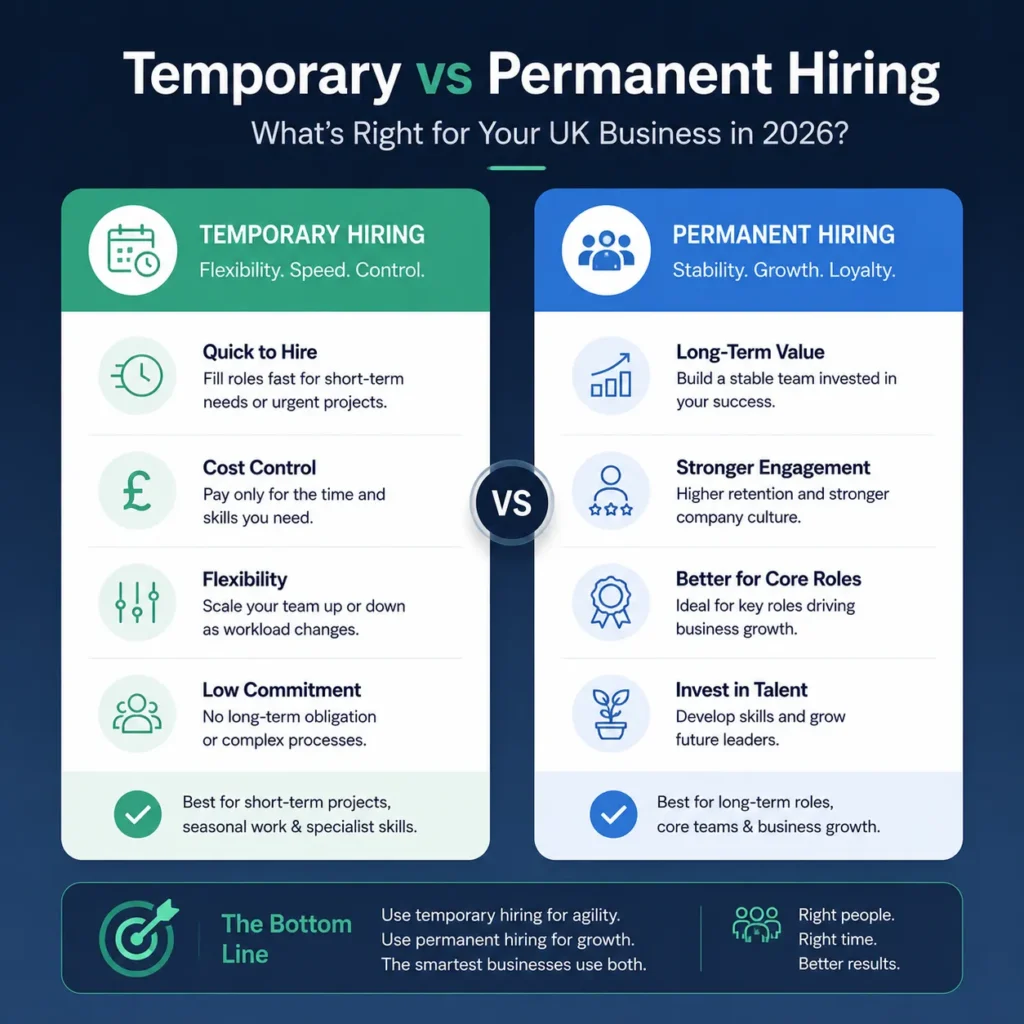
One of the most common questions business owners and HR teams face when a staffing need arises is whether to recruit on a temporary or permanent basis. Both options have distinct advantages and are appropriate in different situations. Understanding the key differences — and when each approach is most effective — can save your business significant time and money. Permanent Recruitment: When It Makes Sense Permanent recruitment is the right choice when you need someone to become a long-term part of your team — someone who will develop institutional knowledge, build relationships with clients or colleagues, and grow with the business. Permanent employees typically bring higher levels of engagement and loyalty, and for roles central to business operations, permanent hiring provides the stability and continuity that contract arrangements cannot replicate. Permanent recruitment makes particular sense for: core technical roles (developers, data engineers, IT managers), customer-facing positions where relationship continuity matters, management and leadership roles, and positions where extensive company-specific training is required. Temporary and Contract Recruitment: When It Makes Sense Temporary or contract recruitment is the right choice when your business has a defined, time-limited need — a project with a clear end date, a seasonal demand spike, or a capability gap while a permanent hire is being sourced. Contract staff are typically highly experienced specialists who can add immediate value without the onboarding curve associated with less experienced permanent hires. Contract recruitment is particularly valuable for: specific project delivery (e.g., a website rebuild or cloud migration), maternity or sick leave cover, interim management during a transition period, and skills that your business needs intermittently rather than full-time. The Cost Comparison Permanent hires carry ongoing salary, employer National Insurance, pension contributions, benefits, and training costs. Contract or temporary staff are typically engaged through an agency at a day rate, with no employer NI or benefits liability — but at a higher per-day cost than an equivalent permanent employee. For short-term needs of less than 6 months, contract hiring is almost always more cost-effective in total. For long-term needs of over 12 months, permanent hiring becomes more economical. The 6–12 month zone requires careful analysis of the specific role, risk level, and business growth projections. Can You Convert a Temporary Hire to Permanent? Yes — and this is a strategy many businesses use effectively. A temporary or contract placement allows you to assess a candidate’s actual performance, team fit, and cultural alignment in real working conditions before committing to a permanent offer. Many businesses find this ‘try before you hire’ approach significantly reduces mis-hire risk. How Techcited Ltd Supports Both Permanent and Contract Hiring Techcited Ltd provides both permanent and contract IT recruitment services across Leicester and the UK. Whether you need a permanent software developer to join your team or a senior project manager to deliver a 6-month technology programme, our consultants will identify the right candidates quickly and manage the process professionally from brief to placement. Frequently Asked Questions Q: What is the typical notice period for temporary/contract IT staff in the UK? A: Contract and temporary workers typically operate on short notice periods — often 1–2 weeks — providing significant workforce flexibility. However, highly specialist contractors may negotiate longer notice arrangements as their skills are in high demand. Q: Are there any legal differences between employing temporary vs permanent staff in the UK? A: Yes. Temporary staff engaged through an agency are typically employed by the agency rather than your business, reducing your employer obligations. However, workers on long-term temporary arrangements may acquire worker rights over time. Techcited Ltd ensures full legal compliance in all placement arrangements. Q: Can Techcited Ltd supply both temporary and permanent staff for the same company? A: Absolutely. Many of our clients use Techcited Ltd as their single recruitment partner for all IT staffing needs — both permanent hires and contract/interim arrangements. Ready to get started? Whether you need a permanent team member or a specialist contractor, Techcited Ltd can help. Get in touch for a free consultation on your next IT hire.

How to Write a Job Description That Attracts the Best IT Candidates
Recruitment

How to Write a Job Description That Attracts the Best IT Candidates in 2026

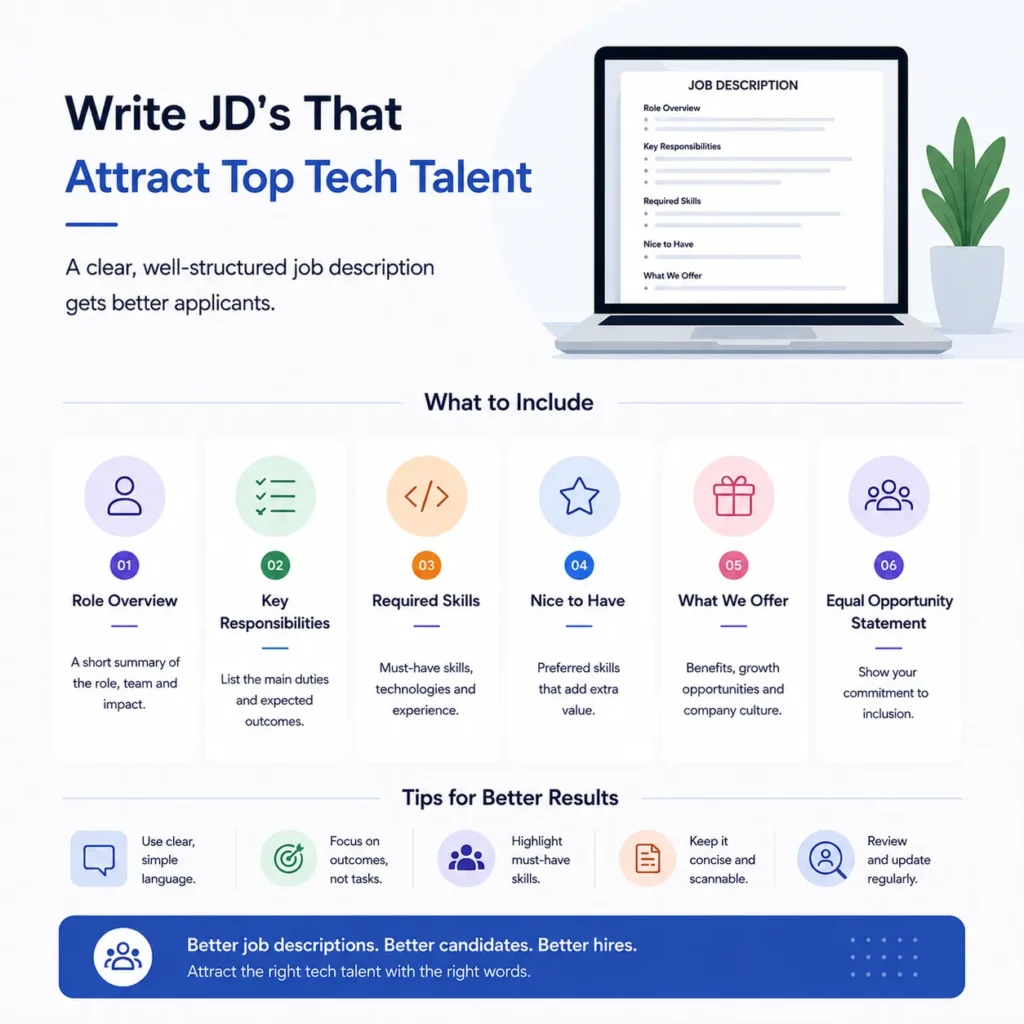
A well-crafted job description is one of the most powerful — and most underutilised — tools in any technology employer’s hiring arsenal. In a competitive market where the best candidates spend an average of just 49 seconds scanning a job posting before deciding whether to apply, the quality of your job description directly determines the quality of your candidate pipeline. This guide provides a practical framework for writing IT and technology job descriptions that consistently attract high-calibre candidates across the UK. The Structure of an Effective IT Job Description Section 1: The Role Headline Use a clear, specific job title that candidates actually search for. Avoid internal titles that mean nothing outside your organisation. ‘Software Engineer (Python, AWS)’ will outperform ‘Technology Rockstar’ every time — both in search visibility and in the quality of applicants it attracts. Section 2: Company Introduction (3–4 sentences) Briefly tell candidates who you are, what you do, and why your company is an interesting place to work. Focus on mission, culture, and what makes you different. Avoid generic statements like ‘we are a dynamic, fast-paced company’ — they say nothing meaningful and every other job advertisement says the same. Section 3: The Opportunity Describe the role’s purpose and its impact. Explain what success looks like in the first 3, 6, and 12 months. Talented candidates are motivated by impact and growth — show them clearly how this role contributes to something meaningful. Section 4: Responsibilities List 6–8 specific, realistic day-to-day responsibilities. Avoid padding this section with broad platitudes. ‘Build and maintain scalable RESTful APIs using Python and FastAPI’ is infinitely more useful than ‘develop software solutions’. Section 5: Required Skills and Experience Separate genuinely essential requirements from nice-to-haves. Research shows that requiring too many ‘essential’ criteria — particularly where some could be learned on the job — significantly reduces applications from diverse candidates. Be honest about which skills are truly non-negotiable. Section 6: What You Offer Salary transparency is increasingly expected by UK candidates and required by law for some roles. List it. Then add: flexible or hybrid working arrangements, professional development budget, meaningful tech stack, team culture, benefits. Do not bury this at the bottom after four paragraphs of requirements. Common IT Job Description Mistakes to Avoid How Techcited Ltd Supports Job Description Quality When you work with Techcited Ltd to fill an IT or technology vacancy, our consultants work collaboratively with you to develop a job brief that is both accurate and compelling. We understand what motivates the candidates you want to attract and how to communicate your opportunity in a way that resonates with them. Frequently Asked Questions Q: Should I include salary in an IT job description in the UK? A: Yes. Salary transparency significantly increases application rates, particularly from experienced candidates who will simply filter out roles without this information. It also reduces wasted time for both parties during the offer stage. Q: How long should an IT job description be? A: Aim for 400–600 words. Long enough to be specific and compelling, short enough to respect the candidate’s time. The most important information — the role, responsibilities, tech stack, and what you offer — should be clear within the first third of the description. Q: Can a recruitment agency help us improve our existing job descriptions? A: Yes. Techcited Ltd offers job brief consultancy as part of our recruitment service. We review your existing descriptions and provide specific recommendations to improve clarity, relevance, and appeal to your target candidates. Ready to get started? Struggling to attract the right IT candidates? Let Techcited Ltd review your job descriptions and recruitment approach. Contact us for a free hiring consultation.

Tech Recruitment Trends Reshaping Hiring in the UK
Recruitment

Tech Recruitment Trends Reshaping Hiring in the UK in 2026

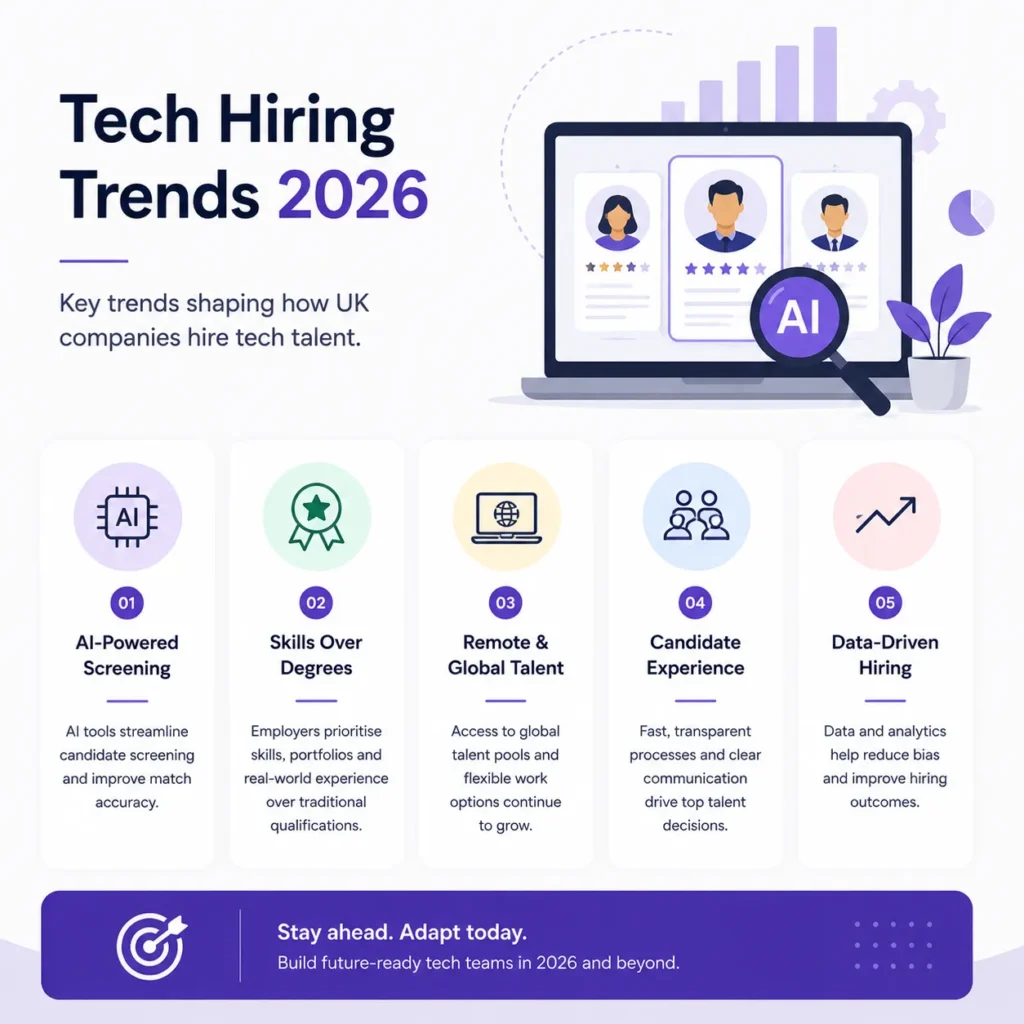
The UK technology recruitment landscape in 2026 looks markedly different from even three years ago. Advances in artificial intelligence, shifts in candidate expectations, the normalisation of remote and hybrid working, and a growing emphasis on skills over credentials are all reshaping how technology businesses find, attract, and hire talent. For UK employers and hiring managers, staying ahead of these trends is not just a competitive advantage — it is a necessity. Here is a comprehensive overview of the key developments transforming tech recruitment this year. 1. Skills-Based Hiring Is Replacing Credential-Based Hiring One of the most significant shifts in UK tech hiring is the move away from degree requirements toward skills-based assessments. Leading technology companies — from global consultancies to Leicester-based digital agencies — are increasingly prioritising demonstrated ability over formal qualifications. This shift benefits both employers and candidates. Employers gain access to a wider, more diverse talent pool. Candidates who have built skills through bootcamps, open-source contributions, or self-directed learning are now genuinely competitive with degree-holders for many roles. 2. AI-Assisted Recruitment Tools Are Mainstream In 2026, AI-powered recruitment tools are no longer optional extras — they are core components of any competitive recruitment process. AI is being used to screen CVs, predict candidate success, reduce unconscious bias, and personalise candidate communications at scale. However, the most effective organisations are using AI to augment human judgement, not replace it. The combination of AI efficiency in screening and human expertise in final-stage assessment consistently outperforms either approach in isolation. 3. Candidate Experience Has Become a Decisive Differentiator With candidate expectations at an all-time high, businesses that offer a poor recruitment experience — slow responses, unclear processes, and impersonal communications — are being left behind. In 2026, candidates routinely share their experiences on LinkedIn, Glassdoor, and tech forums, meaning a bad hiring process has reputational consequences that extend well beyond a single vacancy. 4. Hybrid and Remote Work Expectations Are Non-Negotiable for Many Roles The majority of experienced UK technology professionals now consider flexible or hybrid working arrangements as a baseline expectation, not a benefit. Employers insisting on five-day office attendance for roles that can be performed remotely are significantly restricting their accessible talent pool and increasing their competition for the minority of candidates who prefer office environments. 5. Diversity, Equity, and Inclusion in Tech Hiring Is Under Greater Scrutiny Candidates increasingly scrutinise an employer’s commitment to DE&I before applying or accepting offers. Businesses with visible, actionable DE&I initiatives — not just policy statements — are attracting a more diverse and higher-quality candidate pool. In the technology sector, where diversity of thought drives innovation, this is a strategic as well as ethical priority. How Techcited Ltd Stays Ahead of the Trends At Techcited Ltd, we continuously update our recruitment methodology to reflect the latest developments in technology hiring. From skills-based assessment frameworks to structured DE&I sourcing approaches, we ensure our clients benefit from best-practice recruitment in a rapidly evolving market. Frequently Asked Questions Q: Is skills-based hiring suitable for all technology roles? A: Skills-based hiring works exceptionally well for development, data, and cloud engineering roles where technical proficiency can be directly tested. For leadership and strategic roles, skills assessment is complemented by experience evaluation and leadership capability interviews. Q: How can small UK businesses compete with large tech companies for talent in 2026? A: Focus on what large companies cannot easily offer: genuine career impact, rapid progression, flexible working, close team relationships, and a clear sense of mission. Transparent communication about company culture and values is also highly effective for attracting candidates who prioritise purpose over prestige. Q: What technologies are most in demand from UK employers hiring tech talent in 2026? A: Python, React, Node.js, AWS, Azure, Kubernetes, Flutter, TypeScript, and data engineering tools (Spark, dbt, Snowflake) consistently appear at the top of UK tech hiring demand lists in 2026. Ready to get started? Techcited Ltd keeps your business ahead in the UK tech talent market. Contact us to discuss your 2026 recruitment strategy and how we can help you access the best technology professionals.

How a Recruitment Agency Saves Your Business Time and Money
Recruitment

How a Recruitment Agency Saves Your Business Time and Money in 2026

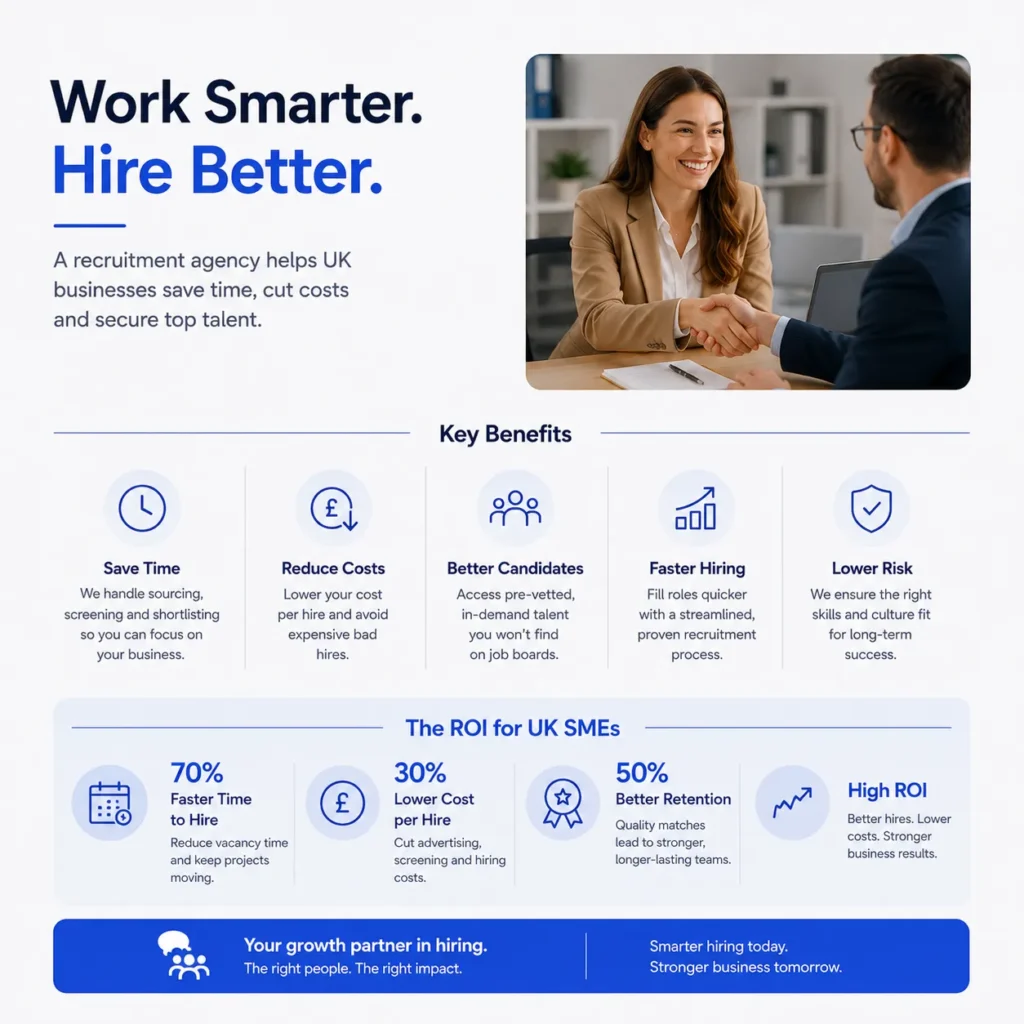
Many business owners and HR managers underestimate the true cost of in-house recruitment. On the surface, posting a job advertisement and reviewing applications might seem straightforward. In reality, the time, resource, and opportunity costs of managing a recruitment process internally — particularly for specialist or senior roles — frequently exceed the cost of an agency fee. This guide breaks down the real financial and operational benefits of working with a specialist recruitment agency, with practical figures to help you make an informed decision. The Hidden Cost of In-House Recruitment Research by the Chartered Institute of Personnel and Development (CIPD) estimates that the average cost of filling a vacancy in the UK is between £3,000 and £6,000 when all internal costs are factored in. For senior or specialist roles, this figure is significantly higher. These costs include: the time taken by HR and hiring managers to write job descriptions, review CVs, conduct interviews, and manage the offer process; job board advertising fees (Indeed, LinkedIn, and specialist tech boards collectively cost £500–£2,000+ per posting); and the lost productivity during the period the role remains unfilled. When you also account for the risk of a bad hire — estimated to cost between 1 and 3 times the employee’s annual salary when recruitment, training, and severance costs are included — the financial case for using an agency becomes compelling. How a Recruitment Agency Reduces Cost Per Hire A specialist recruitment agency eliminates most of the internal cost burden. They write or refine the job brief, advertise across their own channels, screen all applications, conduct initial interviews, perform reference checks, and present you with a shortlist of pre-validated candidates ready for your final decision. Your hiring team’s involvement is focused on the high-value stages only: the final interview and the offer decision. This can reduce the number of internal hours dedicated to a single hire from 40–60 hours to as few as 8–12 hours. Speed of Hire and Business Continuity Every day a critical role remains unfilled has a direct financial impact on your business. Projects stall, existing team members carry additional burden, and in client-facing roles, service quality may suffer. The faster a role is filled with the right candidate, the sooner that business cost is eliminated. Specialist agencies with warm talent pipelines can often present a quality shortlist within 5–7 working days of receiving a brief — significantly faster than most internal recruitment processes. This acceleration in time-to-hire represents a direct and measurable financial benefit. Better Candidate Quality Means Better Retention One of the most financially significant benefits of using a specialist agency is improved candidate quality and, consequently, improved retention. Agencies that thoroughly screen candidates — verifying technical skills, reviewing portfolios, and assessing cultural alignment — are more likely to place candidates who perform well and stay. Every retained hire represents a saving on future recruitment costs. Conversely, every early departure triggers a new recruitment cycle, with all the associated costs and disruption. Good recruitment is therefore an investment in organisational stability, not just an operational expense. The Techcited Ltd Value Proposition At Techcited Ltd, we offer transparent, competitive fee structures and a placement guarantee period that protects your investment. Our specialist IT and technology recruitment service means you receive pre-screened, technically validated candidates — not a pile of unfiltered CVs. We work with businesses across Leicester and the UK to reduce both the cost and time associated with tech hiring, while consistently improving the quality of their teams. Our 5-star Google reviews reflect the trust our clients place in us — and the results we consistently deliver. Frequently Asked Questions Q: Are recruitment agency fees tax deductible for UK businesses? A: Recruitment agency fees paid to find employees are generally allowable as a business expense for UK tax purposes. We recommend confirming this with your accountant for your specific circumstances. Q: What does a typical recruitment agency guarantee period cover? A: Most agencies offer a rebate or free replacement if the placed candidate leaves or is released within an agreed period — typically 8 to 12 weeks. Always confirm the terms in writing before engaging an agency. Q: Is it more cost-effective to use multiple agencies or one specialist? A: For specialist IT roles, working with one specialist agency on an exclusive or preferred supplier basis often delivers better results than multi-agency approaches. Specialist exclusivity motivates the agency to invest more deeply in your search. Ready to get started? Find out how much Techcited Ltd can save your business on your next technology hire. Book a free, no-obligation consultation with our recruitment specialists today.

5 Signs Your Hiring Process Is Costing You TopTech Talent
Recruitment

5 Signs Your Hiring Process Is Costing You TopTech Talent in 2026

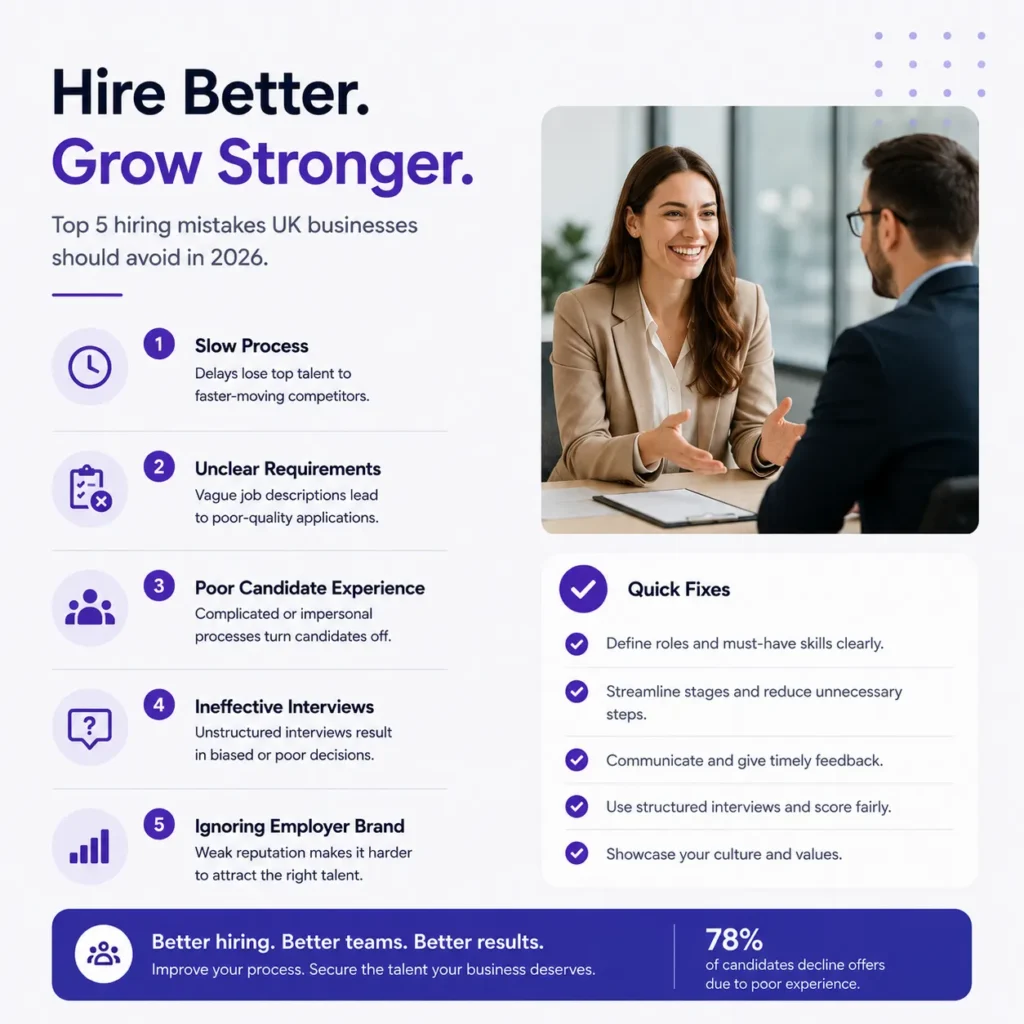
In the competitive UK technology jobs market of 2026, the businesses that consistently attract and land the best candidates are not always those offering the highest salaries. More often, they are the companies that have built hiring processes designed with the candidate experience firmly in mind. If your business is struggling to fill technical roles, receiving rejections from strong candidates, or finding that hired employees leave within their first year, your hiring process itself may be the root cause. Here are five critical warning signs — and practical steps to address each one. Sign 1: Your Time-to-Hire Is Too Long The average time-to-hire for technology roles in the UK is currently 30–45 days. If your process regularly extends beyond this, you are losing candidates to faster-moving competitors. Research consistently shows that the best tech candidates are off the market within 10 days of beginning their job search. Solution: Audit every stage of your process and identify where delays occur. Pre-approved interview panels, defined decision timelines, and delegated offer authority can dramatically reduce time-to-hire. Working with a recruitment agency that manages scheduling and candidate communication removes much of the administrative bottleneck. Sign 2: Your Job Descriptions Are Generic or Unclear A vague job description sends exactly the wrong signal to experienced technical candidates. Posting a job that reads as a list of generic skills requirements rather than a compelling opportunity will attract volume but filter out the thoughtful, career-focused professionals you most want to hire. Solution: Include the specific technologies and tools used, realistic day-to-day responsibilities, team structure, and genuine growth opportunities. Be honest about the challenges of the role. Strong candidates value transparency and are more likely to apply when they feel the company has invested care into how it presents itself. Sign 3: Too Many Interview Stages While thorough assessment is important, excessive interview processes — particularly those involving five or more stages, lengthy technical assessments, and multiple panel interviews — are among the top reasons senior tech candidates drop out of recruitment processes. They signal organisational indecision and poor candidate respect. Solution: Most technical roles can be effectively assessed in three stages: an initial recruiter screen, a technical assessment or practical task, and a hiring manager interview with a brief culture conversation. Reserve additional stages only for senior leadership positions. Sign 4: You Are Not Promoting Your Employer Brand In 2026, candidates research employers thoroughly before applying or accepting offers. If your company has limited online presence, outdated Glassdoor reviews, or a website that does not communicate your culture and values, you are at a significant disadvantage. This is especially true for tech professionals, who are digitally native and highly discerning. Solution: Ensure your careers page is current and reflects real employee stories, team photos, and genuine culture messaging. Actively encourage current employees to share honest reviews on Glassdoor and LinkedIn. Publish thought leadership content that positions your company as a forward-thinking, desirable employer. Sign 5: Your Offer Process Is Slow or Unclear Even after a perfect series of interviews, a slow or poorly managed offer stage can result in a strong candidate accepting a competitor’s offer. Delays between interview and offer, low-ball initial offers, and unclear communication about next steps are all common causes of late-stage candidate loss. Solution: Prepare your offer parameters before the final interview stage, not after. Move to offer within 24–48 hours of a positive final interview decision. Communicate clearly, personally, and warmly — a phone call from the hiring manager or director is far more compelling than a formulaic email. How Techcited Ltd Can Help You Improve Your Hiring Process At Techcited Ltd, we do not just source candidates — we act as your strategic recruitment partner. We can audit your existing hiring process, advise on job description quality, manage interview scheduling, and provide real-time market insight on candidate expectations and salary benchmarks. Our goal is not simply to fill your current vacancy. It is to ensure that your hiring process consistently attracts and secures the best available talent for every role, now and in the future. Frequently Asked Questions Q: What is a reasonable number of interview stages for a senior tech role? A: For most senior technology roles, three stages are sufficient: a recruiter or HR screen, a technical assessment, and a final culture-fit interview with the hiring manager or a senior team member. Additional stages should be the exception, not the norm. Q: How can I reduce my company’s time-to-hire without compromising quality? A: Pre-define your ideal candidate profile before advertising, use a specialist recruitment agency to pre-screen candidates, establish a clear decision-making timeline with your interview panel, and ensure offer approval is not dependent on lengthy internal sign-off chains. Q: Is employer branding important for SMEs or only large companies? A: Employer branding is critically important for SMEs, which often compete with larger companies for the same candidates. Clear culture messaging, genuine employee testimonials, and a professional careers page can significantly level the playing field. Ready to get started? Book a free recruitment consultation with Techcited Ltd and let us review your hiring process. We will help you attract better candidates and reduce time-to-hire significantly.

Scroll to Top
Seraphinite AcceleratorOptimized by Seraphinite Accelerator
Turns on site high speed to be attractive for people and search engines.